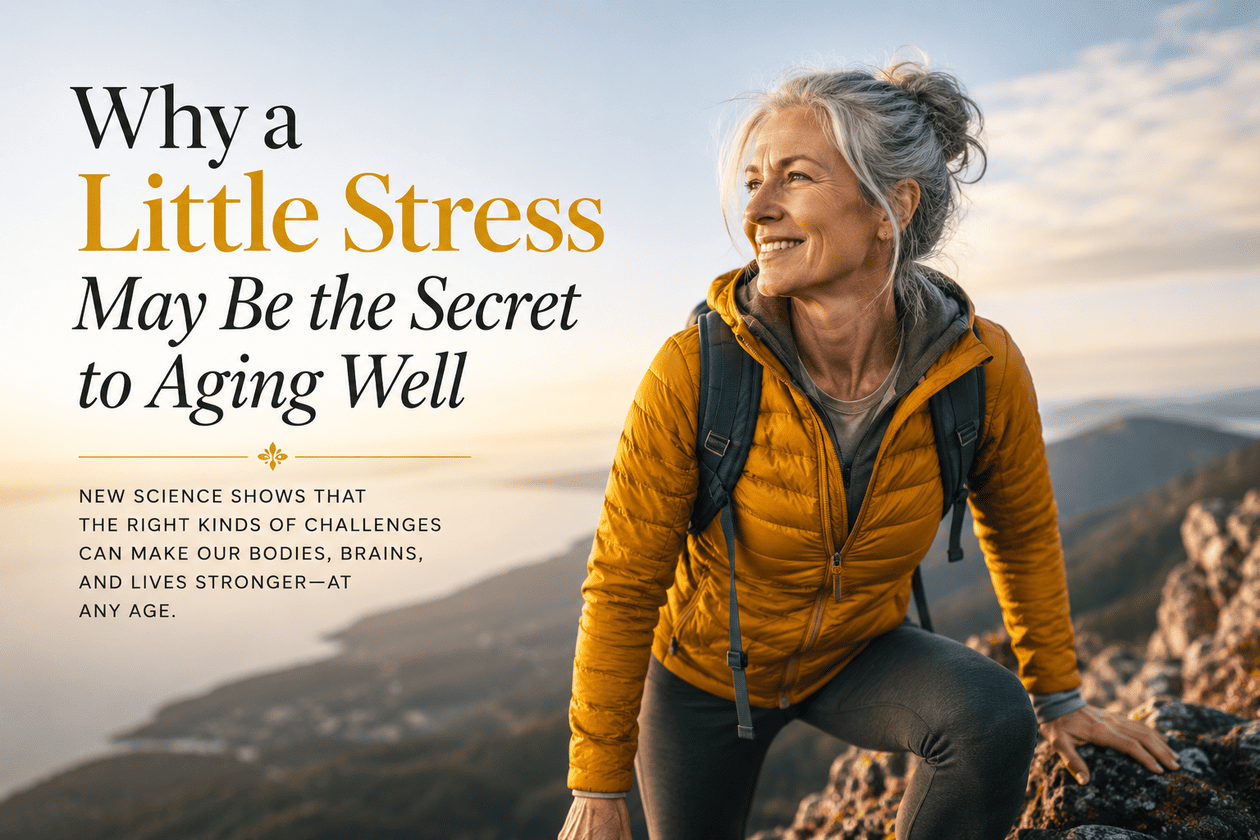
By the time we reach our 50s, 60s, and beyond, many of us have earned the right to seek comfort. After decades of building careers, raising families, navigating relationships, caring for aging parents, and managing life’s endless responsibilities, comfort feels like a reward. We invest in supportive shoes, ergonomic chairs, luxury mattresses, and increasingly convenient ways to simplify our lives. We work hard to reduce stress because we’ve been told for years that stress is bad for us.
And chronic stress absolutely is. But scientists are discovering something surprising: while ongoing stress can damage our health, certain types of short-term stress may actually help us age better.
The concept is called hormesis, and it is rapidly becoming one of the most intriguing areas of longevity research. Hormesis refers to the body’s ability to respond to small, manageable challenges by becoming stronger, more resilient, and better equipped to handle future stressors.
In other words, a little bit of the right kind of stress may be exactly what your body and brain need.
What Exactly Is Hormesis?
Hormesis is a biological phenomenon in which exposure to a mild stressor triggers a positive adaptive response.
Think about what happens when you exercise. Whether you’re lifting weights, hiking a steep trail, or taking a vigorous pickleball class, you’re placing stress on your muscles, cardiovascular system, and metabolism. During the activity, your body is challenged. Afterwards, it recovers and adapts.
The result? Greater strength, endurance, balance, and resilience.
The same principle occurs throughout the body. Mild challenges can activate cellular repair mechanisms, improve metabolic function, strengthen bones, stimulate brain activity, and even enhance the body’s ability to cope with future stress.
The key is that the challenge must be manageable. Hormesis is not about suffering, punishment, or pushing yourself to exhaustion. It’s about providing your body with enough stimulation to encourage growth and adaptation.
As Goldilocks would say, the stress needs to be “just right.”
The Problem With Modern Comfort
For most of human history, humans lived in environments that naturally provided hormetic stress.
People walked long distances. They carried heavy objects. They experienced changes in temperature. They routinely learned new skills necessary for survival. Their days involved movement, problem-solving, and adaptation.
Today’s world is dramatically different. Many of us spend the majority of our day sitting. We move from climate-controlled homes to climate-controlled cars to climate-controlled offices. Food is available at the push of a button. Navigation systems tell us where to go. Streaming services tell us what to watch.
Convenience has improved our lives in countless ways, but it has also removed many of the small challenges our bodies evolved to expect. The result is a paradox. We are more comfortable than any generation before us, yet rates of obesity, metabolic disease, frailty, and cognitive decline continue to rise.
Our bodies were built to adapt. When we stop giving them opportunities to do so, they often become less capable over time.
Why Hormesis Matters More After 50
If you’re over 50, hormesis becomes especially important because many of the systems that naturally decline with age respond remarkably well to challenge.
Muscle mass begins decreasing as early as our 30s, with the rate accelerating after menopause. Bone density declines. Balance becomes less stable. Metabolism slows. Cognitive processing speed can decrease.
The encouraging news is that these changes are not entirely inevitable. Research consistently shows that older adults maintain an extraordinary capacity to adapt when appropriately challenged.
Women in their 60s, 70s, and even 80s can build muscle through resistance training. New neural connections can form throughout life. Balance can improve. Cardiovascular fitness can increase. Confidence can grow.
The body never completely loses its ability to respond to stimulation. What often changes is our willingness to provide that stimulation.
Many women begin to unconsciously shrink their worlds as they age. They stop trying new activities because they don’t want to look inexperienced. They travel less because it feels easier to stay home. They avoid technology because learning it feels frustrating. They decline invitations because staying in feels more comfortable.
While these choices may feel harmless individually, over time they can contribute to physical, cognitive, and social decline. Hormesis suggests the opposite approach: keep expanding.
Your Brain Loves a Challenge
One of the most exciting areas of hormesis research involves brain health. Many people assume cognitive decline is simply part of aging. While some changes are normal, researchers now understand that the brain remains surprisingly adaptable throughout life.
When we learn something new, our brains create and strengthen neural connections. This process, known as neuroplasticity, continues well into older adulthood.
Learning a language, taking a painting class, mastering artificial intelligence tools, playing a musical instrument, or even navigating an unfamiliar city all require the brain to work harder than usual. That effort stimulates growth.
This may help explain why some people seem mentally sharp well into their 80s and 90s. They never stop learning.
The challenge itself becomes part of the anti-aging strategy. The next time you feel frustrated while learning a new technology platform, remember that frustration may actually be evidence that your brain is doing exactly what it should be doing.
The Hidden Benefits of Being Bad at Something
Most of us enjoy activities we’re already good at. We like feeling competent. Unfortunately, competence isn’t always where growth happens. Growth often occurs when we feel awkward, uncertain, and slightly out of our depth.
Think about your first pickleball lesson. Your first yoga class. Your first attempt at using ChatGPT. Your first solo trip abroad. Chances are you weren’t particularly skilled. You may have felt clumsy, confused, or even a little embarrassed. Those feelings aren’t signs that you should quit. They are signs that your brain and body are adapting.
One of the healthiest habits we can develop as we age is becoming comfortable with temporary incompetence. Children learn this naturally. Adults often avoid it. The women who continue to grow throughout their lives are usually the ones willing to be beginners again and again.
Seven Simple Ways to Practice Hormesis
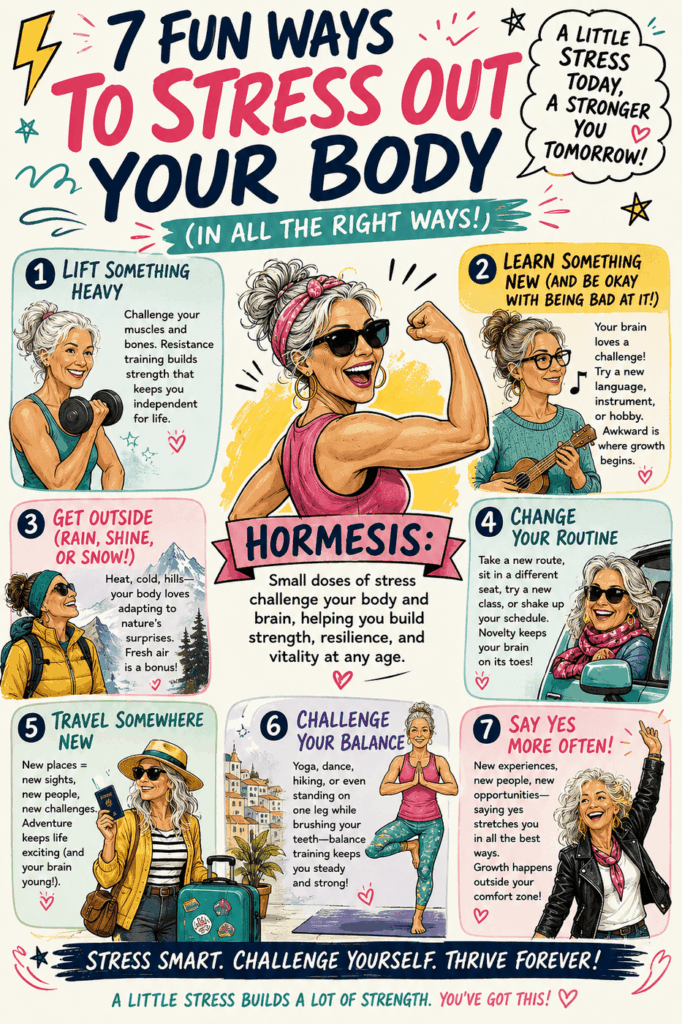
You don’t need to climb Mount Everest or run an ultramarathon to benefit from hormesis. Small challenges performed consistently can have a profound impact.
1. Lift Something Heavy
Resistance training remains one of the most powerful anti-aging tools available. Strength training helps preserve muscle, improve bone density, enhance metabolism, and support independence as we age.
2. Learn a New Skill
Take a language class. Learn bridge. Explore artificial intelligence. Pick up a musical instrument. The more mentally demanding the activity, the greater the potential benefit.
3. Change Your Routine
Take a different route to work. Visit a new neighborhood. Explore a museum you’ve never visited. Novel experiences stimulate the brain in powerful ways.
4. Embrace Temperature Changes
Within reason and if needed with your physician’s guidance, activities such as sauna use, cold-water exposure, or simply spending more time outdoors can challenge the body’s adaptive systems.
5. Travel Somewhere New
Travel combines novelty, problem-solving, social interaction, and physical activity into one powerful hormetic package.
6. Challenge Your Balance
Yoga, Pilates, dance classes, hiking trails, and balance exercises all help strengthen systems that become increasingly important with age.
7. Say Yes More Often
Sometimes the most important challenge isn’t physical. It’s social. Join the group. Attend the event. Start the business. Volunteer for the leadership role. Growth often begins with a simple yes.
The Difference Between Challenge and Overload
Hormesis works because the challenge is temporary. Chronic stress, the kind associated with financial worries, caregiving burdens, sleep deprivation, or constant anxiety, is not beneficial. In fact, it can accelerate aging and contribute to numerous health problems.
The goal is not to add more stress to an already stressful life. The goal is to intentionally introduce manageable challenges that allow the body and brain to adapt and grow stronger.
Think of it this way: exercise strengthens the body because it is followed by recovery. Without recovery, exercise becomes injury.
The same principle applies to all forms of hormesis. Challenge and recover. Stretch and recover. Learn and recover. The magic happens during adaptation.
The Takeaway
For years, we’ve been told to reduce stress. The truth is more nuanced than that. We should absolutely reduce chronic, harmful stress. But we should also recognize that our bodies and brains need challenge to thrive.
The science of hormesis suggests that some of the most powerful anti-aging strategies are not found in a supplement bottle or expensive skincare product. They are found in the moments when we push ourselves slightly beyond what feels comfortable.
Take the class. Book the trip. Learn the technology. Lift the weights. Try the new hobby. Make yourself just a little uncomfortable. Your future self may thank you for it.
The key takeaways were created with the assistance of generative AI. A Prime Women editor reviewed and refined the content for accuracy and clarity.
Read Next:
Can’t Sleep Because You’re Stressed? Try Tapping Your Way to Calm