

You sit down to enjoy a bowl of soup, a plate of enchiladas, or perhaps something completely innocent like Sunday brunch. Within minutes, your nose begins running as if you have suddenly developed a terrible cold right there between the appetizer and the entrée.
You are not congested, sick, or necessarily allergic to anything on your plate. Your nose has simply decided that lunch requires its full participation.
This surprisingly common reaction has a name: gustatory rhinitis. It is a form of nonallergic rhinitis that causes watery nasal drainage during or shortly after eating, particularly when a meal is spicy, steaming hot, or strongly flavored. It can occur at any age, but age-related forms of gustatory rhinitis are recognized, and nasal symptoms in general are common among older adults. I’ve dealt with this most of my adult life, and it doesn’t matter what I eat.
The condition is usually harmless, but that does not mean it is not irritating. Constantly reaching for a napkin during dinner is hardly the elegant dining experience any of us had in mind.
What Is Gustatory Rhinitis?
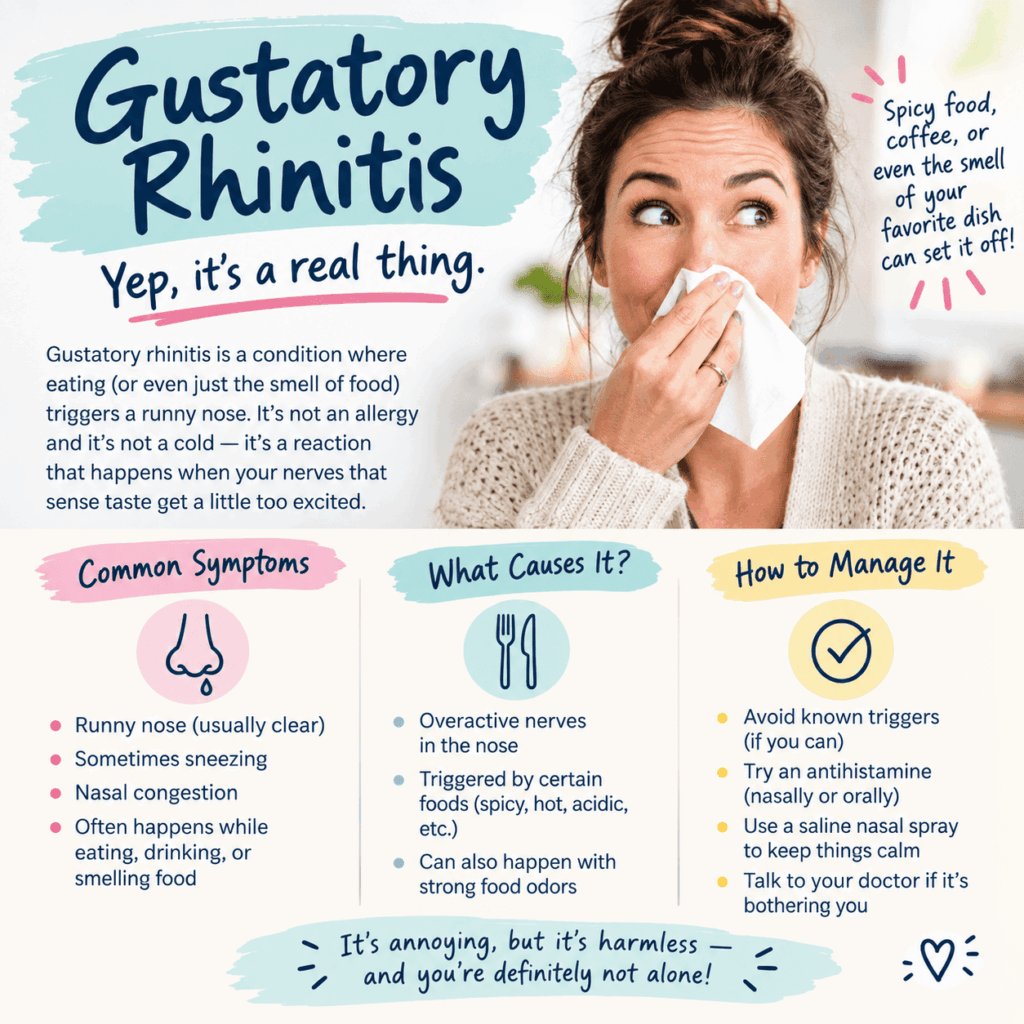
Gustatory rhinitis is a reflex reaction rather than an infection or traditional allergy. Eating or drinking triggers nerves in the upper airway, which then activate the parasympathetic nervous system and tell glands inside the nose to produce more fluid. The result is a sudden stream of thin, watery drainage from one or both nostrils.
Symptoms usually begin within minutes of eating. Unlike classic allergic rhinitis, gustatory rhinitis generally does not cause an itchy nose, itchy eyes, facial pain, significant congestion, or repeated sneezing. The main complaint is simply that the nose starts running, often with impressively inconvenient timing.
Hot chili peppers are among the best-known culprits, but they are not the only ones. Hot soup, curry, salsa, horseradish, strong spices, alcohol, and foods served at a high temperature may all set off the reflex in susceptible people. One outpatient survey found chili peppers were the most frequently reported trigger, although the study population came from a clinic and should not be treated as a population-wide estimate of how common the condition is.
Why Might It Become More Noticeable After 50?
Our noses age along with the rest of us, although they receive considerably less attention than our faces. Older adults can experience changes in nasal structure, mucus production, blood flow, nerve signaling, and the tiny hairs that help move mucus through the nasal passages.
A medical review found that symptoms such as a runny nose, congestion, sneezing, itching, and postnasal drainage affect as many as 32 percent of older adults. Researchers also note that nonallergic forms of rhinitis become particularly important in later life because aging can alter how the nose responds to temperature, odors, food, medication, and other triggers.
That does not mean turning 50 automatically causes your nose to run into your soup. It does mean that a reflex you barely noticed years ago may become much more obvious as the nasal tissues and nervous system change.
This Is Not Usually a Food Allergy
The word “food” understandably makes many women wonder whether they have developed an allergy. Gustatory rhinitis, however, is considered a non-immunological reaction. Your immune system is not mistaking the salsa for a dangerous invader; your nasal nerves are simply overreacting to the sensory experience.
A watery nose that starts while eating and stops shortly afterward, without other symptoms, fits the typical gustatory-rhinitis pattern. A food allergy can cause a broader reaction that may include itching, hives, swelling, digestive symptoms, wheezing, coughing, dizziness, or difficulty breathing. Severe allergic reactions can be life-threatening and require immediate medical care.
This distinction matters because allergy tablets are not designed to treat every kind of runny nose. If histamine is not driving the reaction, repeatedly taking an antihistamine may do little besides dry out your mouth and make you wonder why the “allergy medicine” is failing.
Start by Playing Food Detective

Before abandoning every flavorful meal you enjoy, spend two weeks noticing exactly when the problem occurs. Write down what you ate, whether the food was spicy or very hot, how quickly the drainage began, how long it lasted, and whether you experienced itching, sneezing, congestion, or symptoms elsewhere in the body.
Patterns are often more useful than assumptions. You may discover that tomato soup causes no problem once it has cooled slightly, while piping-hot broth has you reaching for tissues before the third spoonful. You might tolerate mild salsa beautifully but react to horseradish as though it has personally insulted your nasal passages.
A small notebook works perfectly well for this, although a notes app on your phone is easier to use discreetly in restaurants. You do not need an expensive wellness journal unless attractive stationery makes the investigation more enjoyable.
You May Not Need to Give Up Spicy Food
Avoiding a trigger is the simplest treatment, but it is not always necessary or appealing. In one survey, many participants continued eating foods that caused symptoms because the irritation was not bothersome enough to sacrifice the food. Apparently, some of us are willing to keep a tissue in one hand if it means keeping the enchilada in the other.
You may be able to reduce symptoms by choosing a milder spice level, allowing hot food to cool before eating, limiting alcohol with the meal, or saving your most reliable trigger foods for occasions when a runny nose will not bother you. This is less about following rigid rules and more about deciding when the food is worth the inconvenience.
Keeping soft, lotion-treated pocket tissues in your purse can also prevent irritation around the nostrils. It is not a glamorous product recommendation, but neither is arriving at dinner unprepared while your nose behaves like a leaky faucet.
A Prescription Nasal Spray May Help
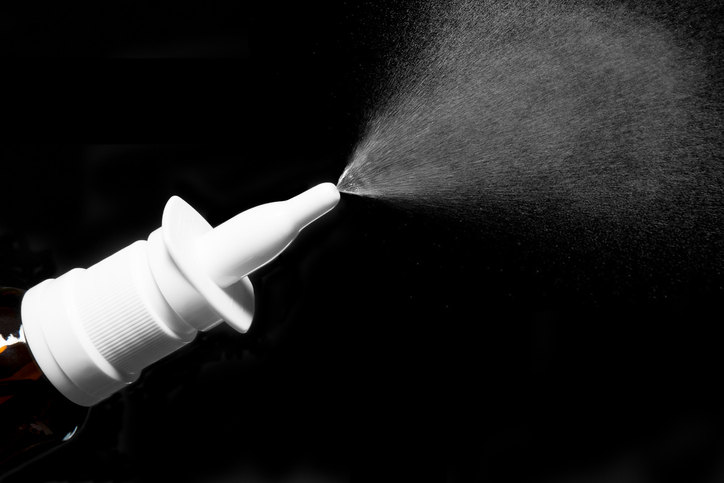
When symptoms are frequent or disruptive, a healthcare provider may recommend an anticholinergic nasal spray such as ipratropium bromide. This medication reduces secretions from glands in the nasal lining, which makes it particularly useful when watery drainage is the primary problem. Research reviews of gustatory rhinitis identify topical anticholinergic treatment as an effective option, and prescription ipratropium is approved for runny nose associated with allergic and nonallergic perennial rhinitis.
Ipratropium can reduce nasal dripping, but it does not reliably treat congestion, sneezing, or postnasal drip.
This is a prescription medication, so discuss it with your physician rather than borrowing someone else’s bottle or guessing about timing. Potential side effects include nasal dryness, irritation, and nosebleeds. It must be kept out of the eyes, and extra caution may be needed for people with narrow-angle glaucoma, bladder-emptying problems, or certain other medical conditions.
Why Random Allergy Products May Disappoint You
If your only symptom is clear drainage that begins with food, an oral antihistamine may not address the underlying reflex. Steroid nasal sprays are also intended primarily to reduce inflammation and are not automatically the best match for an isolated case of food-triggered dripping.
That does not mean these products are never appropriate. Some people have mixed rhinitis, meaning they have both allergic and nonallergic triggers. A woman might react to pollen in the morning, perfume in the afternoon, and spicy curry at dinner, because apparently one variety of nasal irritation was not enough. Medical evaluation can help sort out which treatments match which symptoms.
When a Runny Nose Needs a Closer Look
A nose that runs briefly while you eat is usually more embarrassing than dangerous. However, symptoms deserve medical evaluation if they occur throughout the day, repeatedly affect only one nostril, contain blood, smell unpleasant, or arrive with facial pain, fever, severe congestion, loss of smell, frequent nosebleeds, or unexplained headaches.
You should also make an appointment if the problem began after nasal surgery, facial surgery, or a head injury. The medical literature recognizes postsurgical, post-traumatic, and nerve-related forms of gustatory rhinorrhea, which may require a more specialized evaluation.
Seek urgent care for breathing difficulty, faintness, widespread hives, or swelling of the lips, tongue, face, or throat after eating. Those symptoms do not fit simple gustatory rhinitis and may indicate a serious allergic reaction.
The Bottom Line
If your nose runs every time you eat, particularly when meals are hot or spicy, you may have gustatory rhinitis rather than a cold or food allergy. It is a nerve-driven nasal reflex that can become more noticeable as we age, and it usually causes watery drainage without the itching, swelling, or congestion associated with many allergies.
Start by tracking your triggers and experimenting with food temperature and spice levels. If the problem interferes with meals, social events, or your ability to wear foundation anywhere near your nose, talk with your healthcare provider about whether a targeted nasal spray is appropriate.
You should be able to enjoy dinner without using half the restaurant’s napkin supply. Your nose may insist on joining the meal, but it does not need to become the main course.