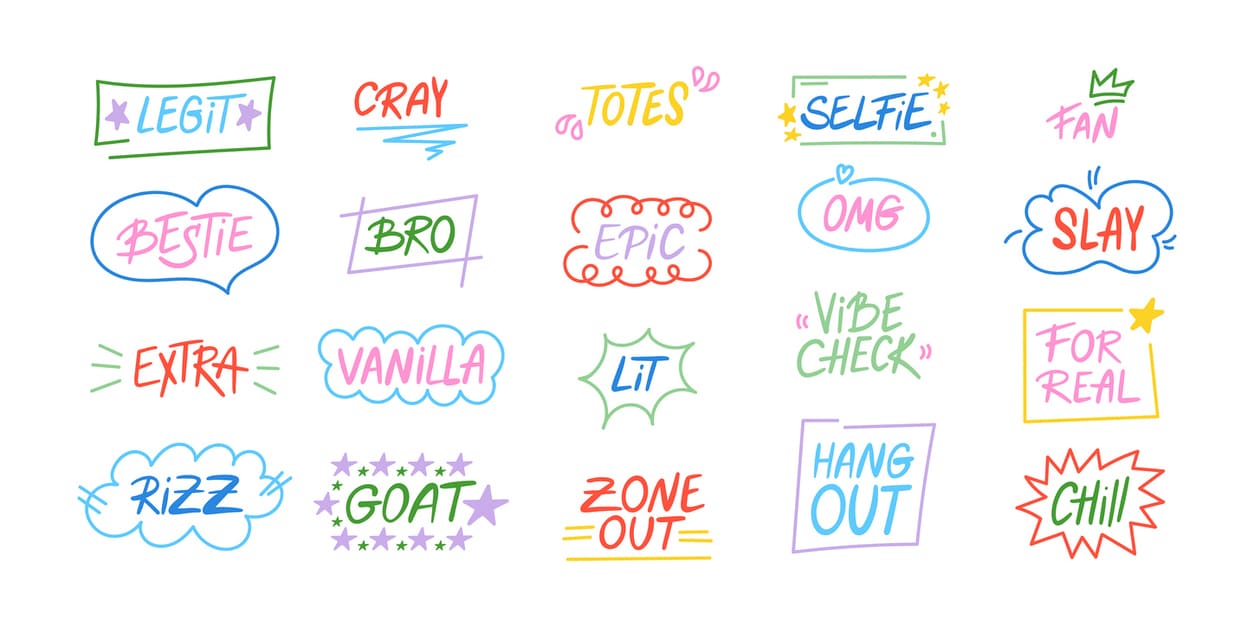
Pull up a chair and pour yourself a cup of whatever makes the day sweeter. If your children or grandchildren are speaking in what sounds like an entirely different language, you are not alone. Gen Z loves short, snappy words that pack a lot of meaning. I’m here to help you decode the common ones, so you can smile knowingly (or playfully pretend you invented them) the next time someone says something baffling at the dinner table.
Why Gen Z Slang Sounds Like a Different Language
Gen Z grew up with memes, TikTok, Twitter (X), group chats, and global culture all at their fingertips. Shortness is key — fewer letters, faster laughs. Many words change meaning depending on tone and context. Also: words move in and out of style quickly. Don’t worry about memorizing everything; knowing the gist and how to respond kindly will get you through most conversations.
Common Slang You’ll Hear (What It Means and How to Respond)
Below are words you’re likely to hear — each with a short definition, pronunciation tip, an example sentence, and a quick suggestion for how you might respond.
Rizz (pronounced: “rizz”)
- Meaning: Short for charisma, it refers to someone’s ability to flirt or charm others. It can also describe style or attractiveness.
- Example: “He’s got mad rizz.”
- How to respond: “Sounds like he’s got a way with words!”
Fam (pronounced: “fam”)
- Meaning: A shortened version of “family,” used to describe close friends or those regarded as family, regardless of biological ties.
- Example: “We had a great time with the fam at dinner last night.”
- How to respond: “It’s always good to spend time with your fam.”
Cap / No cap (pronounced: “kap”)
- Meaning: “Cap” = lie; “no cap” = I’m serious / no lie.
- Example: “He said he finished his homework — no cap.”
- How to respond: Smile and say, “No cap, huh? Got it.” Or ask, “Why would he cap about that?”
Sus (pronounced: “suss”)
- Meaning: Suspicious or shady.
- Example: “His excuse for being late was sus.”
- How to respond: “That does seem suspicious — thanks for flagging it.”
Simp (pronounced: “simp”)
- Meaning: Someone who goes overboard to please or fawn over someone, often romantically.
- Example: “He bought her ten gifts — total simp energy.”
- How to respond: Laugh it off: “We all have our simp moments!”
GOAT (pronounced: letters G-O-A-T)
- Meaning: Greatest Of All Time.
- Example: “That actor is the GOAT.”
- How to respond: “He is fabulous — GOAT status!”
Slay (pronounced: “slay”)
- Meaning: To do something exceptionally well, especially the look or performance.
- Example: “She slayed at the recital.”
- How to respond: “Tell her Nana said she slayed!”
Bet (pronounced: “bet”)
- Meaning: Agreement or “okay/sure” (can also mean “watch me” in a challenge).
- Example: “You want to go later?” — “Bet.”
- How to respond: Use it lightly: “Bet — sounds good to me.”
Mood (pronounced: “mood”)
- Meaning: Something relatable; “that’s how I feel.”
- Example: Someone posts a picture of a cozy blanket and you say, “Mood.”
- How to respond: Laugh: “That’s my mood today, too!”
Periodt (pronounced: “peer-ee-uhdt”)
- Meaning: An emphatic “period” — end of discussion.
- Example: “She’s the best — periodt.”
- How to respond: “Periodt — love that conviction!”
Tea / Spill the tea (pronounced: “tee”)
- Meaning: Gossip / the latest news. “Spill the tea” = tell the gossip.
- Example: “Spill the tea — what happened at the party?”
- How to respond: “Oh honey, let me hear it — but keep it kind.”
Flex (pronounced: “flex”)
- Meaning: To show off.
- Example: “Posting that new car is a big flex.”
- How to respond: “They’re proud — as long as it’s not mean-spirited.”
Lowkey / Highkey (pronounced: “loh-kee” / “h-eye-kee”)
- Meaning: Lowkey = secretly/slightly; Highkey = openly/definitely.
- Example: “I lowkey want that dress.” / “I highkey love that song.”
- How to respond: “Lowkey — I get that little wish. Highkey — louder for the people in the back.”
Glow up (pronounced: “gloh up”)
- Meaning: Major transformation for the better (appearance, confidence).
- Example: “She had a huge glow up since college.”
- How to respond: “She looks great — what a glow up!”
Yeet (pronounced: “yeet”)
- Meaning: Exclamation of excitement or to throw something energetically.
- Example: “Yeet!” when something great happens, or “He yeeted the ball.”
- How to respond: Smile and ride the energy: “Yeet — that’s fun!”
Based (pronounced: “baysd”)
- Meaning: Confidently authentic; often used approvingly.
- Example: “That’s a based take.”
- How to respond: “I like that — it’s refreshingly honest.”
OK Boomer (pronounced: “oh-kay BOO-mer”)
- Meaning: A dismissive reply to an older person seen as out-of-touch; can be playful or rude.
- Example: Young person brushes off an older person’s comment with “OK boomer.”
- How to respond: Best to laugh it off or say, “Tell me why — I might learn something.”
Bop (pronounced: “bop”)
- Meaning: A very good song.
- Example: “That new track is a bop.”
- How to respond: “I’ll put it on — I love a bop.”
Fit (pronounced: “fit”)
- Meaning: Outfit.
- Example: “Love your fit!”
- How to respond: “Thank you — outfit choice made me feel good today.”
Cheugy (pronounced: “chew-gee”)
- Meaning: Out of date or trying too hard (a bit like uncool).
- Example: “That trend is cheugy now.”
- How to respond: “Trends change — we’ve been there before!”
Sksksk / And I oop (pronounced: a series of hissing laughs / “and I oop”)
- Meaning: Sksksk = excited/nervous laughter in text; “and I oop = reaction to something surprising or awkward.
- Example: “Sksksk I can’t” or “And I oop — did you drop it?”
- How to respond: Laugh and mirror: “Sksksk — that made me smile.”
Rent free (pronounced: “rent free”)
- Meaning: Something (or someone) that stays in your head without paying rent — often a catchy song or thought.
- Example: “That jingle lives rent free in my head.”
- How to respond: “Mine too — it’s stuck all day!”
FYP (pronounced: letters F-Y-P)
- Meaning: For You Page (TikTok) — what shows up in your curated feed.
- Example: “It went viral on my FYP.”
- How to respond: “TikTok has its own world — fascinating!”
Main character energy (pronounced as written)
- Meaning: Acting like your life is a movie; confident and unapologetically focused on yourself.
- Example: “She walked into the room with main character energy.”
- How to respond: “Love that — own your scene!”

When It’s Playful vs. When to Worry
Playful: Most slang is harmless — a quick way to bond, joke, or exaggerate. If your grandchild calls a song a “bop” or says “mood” under a photo, it’s usually fun.
Worrying signs: If slang accompanies mean behavior, manipulation, or secrecy (e.g., bullying called “just joking,” or sudden secretive texting), treat the language as a clue and ask gentle, direct questions. Language can mask underlying problems; focus on the behavior, not just the words.
How to Keep Up Without Trying Too Hard
- Ask instead of guessing: “What does that mean?” shows curiosity and humility — they’ll often enjoy explaining.
- Use one or two phrases naturally: choose words that feel comfortable, like “mood,” “bet,” or “bop.” Overusing slang can come off as trying too hard.
- Follow their lead: If they respond with a smile or laugh, you’re doing fine.
- Learn through media: Watch a short TikTok or two with them — it’s the fastest translator for current slang.
Fun Conversation Starters You Can Try
- “Okay, so what’s a bop right now? Recommend one for my playlist.”
- “Help me decode this: someone texted ‘no cap’ — are they serious?”
- “Show me one TikTok and I’ll tell you if it gives ‘main character energy’ or ‘cheugy.’”
- “Teach me one slang word and I’ll teach you a word we used in the ‘80s!”
Quick Cheat Sheet (Save this on your phone)
- Rizz = charisma or flirting skills.
- Fam = close friends or family.
- No cap = I’m serious.
- Sus = suspicious.
- GOAT = greatest of all time.
- Bet = okay/sure.
- Mood = feeling or relatable moment.
- Periodt = end of discussion.
- Tea = gossip.
- Lowkey/Highkey = slightly/openly.
- Glow up = major improvement.
- Yeet = throw/exclaim.
- Bop = great song.
- Fit = outfit.
- Cheugy = trying-too-hard/outdated.
- Rent free = stuck in your head.
Parting Thoughts
Language evolves — each generation creates its own shorthand to express ideas quickly and playfully. You don’t need to be fluent to connect. A smile, curiosity, and a little humor go a long way. And when all else fails, say, “Translate that again for Grandma,” — they’ll love explaining, and you’ll both get a laugh.
You’ve got this. Next family dinner, you’ll be the one who drops a perfectly timed “bet” or “mood,” and everyone will cheer.