
When you turn 50, something magical happens. Suddenly, you’re brave. You feel you can stand up for yourself and do what you’ve always wanted to do. Maybe the kids are grown or in college; your life doesn’t center on them as much as it used to, and now you’re at a point where you want to focus on you.
That’s what happened to me. I was 48 and needed to change my life. I worked my entire life, putting myself through college and grad school, and then started my own business. Soon after, I had children. Between my children, my elderly parents, and my business, I had my hands full. There was no time to focus on me.
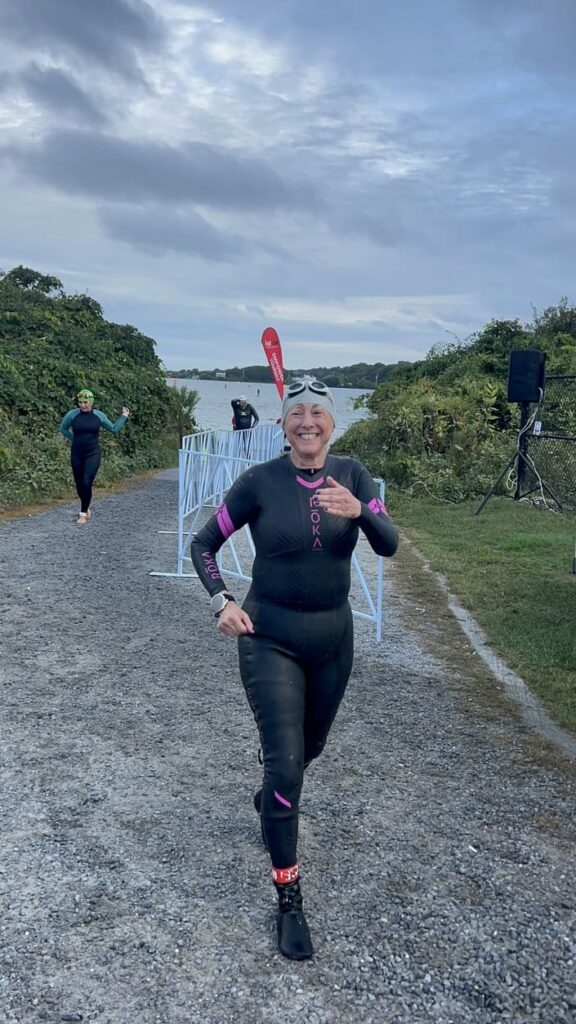
I joined a gym at 48 and started running for the first time in my life. When I wanted a greater challenge, I focused on triathlons. I had never seen one before, but the idea of putting together a swim, bike, and run in one event intrigued me. After that, I was hooked. The feeling of crossing the finish line was incredible. I did something so far outside my comfort zone, and I blame it all on a midlife crisis. (Although ten years later, I’m still doing it. This is a long midlife crisis!)
If you’ve ever wanted to try a triathlon, whether it’s a sprint or an Olympic distance, you absolutely can. Age is just a number on your race bib. Here is how you can navigate the waters (pun intended) and get started.
Understanding the Distances
One of the biggest misconceptions about triathlons is that they are all Ironman events (which are incredibly long). The sport is accessible because it offers a range of distances. Here is a breakdown to help you choose the challenge that fits your current fitness level:
- Super Sprint: The perfect entry point. It typically involves a 400m swim, a 10km (6.2 miles) bike ride, and a 2.5km (1.5 miles) run. It’s short enough to be manageable but long enough to feel like a real accomplishment.
- Sprint: The most popular distance for beginners. It usually consists of a 750m swim, a 20km (12.4 miles) bike ride, and a 5km (3.1 miles) run.
- Olympic (Standard): This doubles the Sprint distance. You’re looking at a 1.5km swim, 40km (24.8 miles) bike ride, and a 10km (6.2 miles) run.
- Half Ironman (70.3): For those looking for a serious endurance event, this covers 70.3 total miles: a 1.9km swim, 90km bike, and a 21.1km (half-marathon) run.
- Ironman (140.6): The ultimate endurance test. A 3.8km swim, 180km bike, and a 42.2km (full marathon) run.
Tips for the Woman of a “Certain Age”
Training in your 50s and 60s isn’t the same as training in your 20s—and that’s okay. We have the wisdom, patience, and grit that younger athletes often lack. However, we need to respect our physiology.
1. Recovery is Your Fourth Discipline
In triathlon, there are three basic disciplines: swim, bike, and run. For women over 50, rest is the fourth and arguably most important discipline. Our bodies take longer to repair muscle tissue and replenish energy stores.
- Don’t skip rest days.
- Prioritize sleep like it’s a job.
- If you feel unusually fatigued, swap a workout for a gentle yoga session or a walk. Overtraining leads to injury, and at our age, injuries can take longer to heal.
2. Strength Training is Non-Negotiable
As we age, we naturally lose muscle mass and bone density. Strength training combats this directly. You don’t need to be a bodybuilder, but incorporating resistance training two times a week will help protect your joints from the impact of running and give you more power on the bike. Focus on core stability, glutes, and hips. If you need help in this area, there are plenty of YouTube videos and great apps, like Dynamic Triathlete, which I love because it’s 20 minutes and the workouts aren’t complicated.
3. Get a Gear Fit
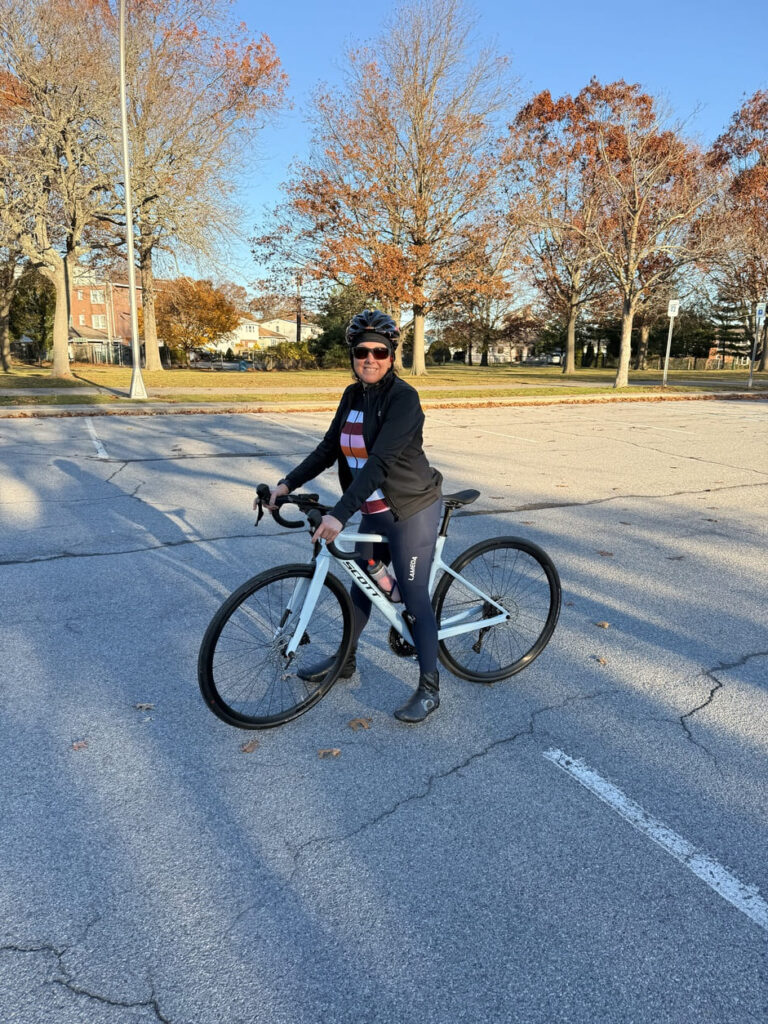
Comfort is queen. If your bike doesn’t fit properly, your back and knees will scream at you. Go to a local bike shop for a professional fitting. Similarly, get fitted for proper running shoes that support your gait. Investing in the right gear isn’t about vanity; it’s about injury prevention.
Remember, when you first get started, you don’t have to spend a lot on gear. If you borrow a bike or buy a used one, make sure it’s properly fitted to you.
4. Listen to Your Body, Not the Schedule
If your training plan says “run 5 miles” but your knees are aching, listen to your knees. Swap the run for a swim or a bike ride, both of which are non-impact. The goal is to get to the start line healthy, not to check every box on a piece of paper perfectly.
5. Find Your Tribe
Triathlon can be a lonely sport if you do it solo. Look for local triathlon clubs or women’s running groups. Finding a community of supportive women who are also juggling life, menopause, and aging parents can make tough training days much more bearable. I have a running group that meets every Sunday, and we just laugh the entire hour or two we are out on the field. You will find your tribe. Triathletes are generally inclusive.
Starting a new sport in midlife is an act of rebellion against the notion that we should slow down. You have earned the right to focus on yourself. So, sign up for that Super Sprint. Buy the goggles. You might just find that your “midlife crisis” is actually a midlife awakening. See you at the finish line.
—–
Hilary JM Topper, MPA, is the author of Unlocking the Triathlon: The Beginner’s Guide to Competing in a Triathlon, published by Meyer & Meyer Sport in November 2025. This is her second endurance book. Her first, From Couch Potato to Endurance Athlete – a Portrait of a Non-Athletic Triathlete, was published in 2022. She is also a certified USA Triathlon Coach, USMS Swim Coach, Adult Learn-to-Swim Coach, WOWSA Open Water Coach, ESCI Endurance Coach, and RRCA Run Coach. Hilary is very active on social media and can be found athttp://www.instagram.com/hilarytopper.