

By Svetlana Rodina
At some point, many of us discover that our idea of who we are contains quite a few borrowed sentences.
She is the sensible one. She hates change. She has always been strong. She is difficult. She takes after her father. She would never do something like that.
None of these descriptions has to be malicious, or even wrong. That is what makes them so persuasive. A family notices something about a child, repeats it often enough, and over time an observation becomes a character trait, then a role, and eventually something that sounds suspiciously like destiny.
The strange part is that a description can remain in place long after the person has changed.
A woman may spend thirty years thinking of herself as cautious while building a career, raising children, surviving losses and moving across a continent. Another may still call herself impractical because that was the family verdict when she was seventeen, although everyone now phones her when something goes wrong.
By the time we reach our fifties, the distance between the person we were told we were and the life we have actually lived can become hard to ignore.
That distance is what interests me.
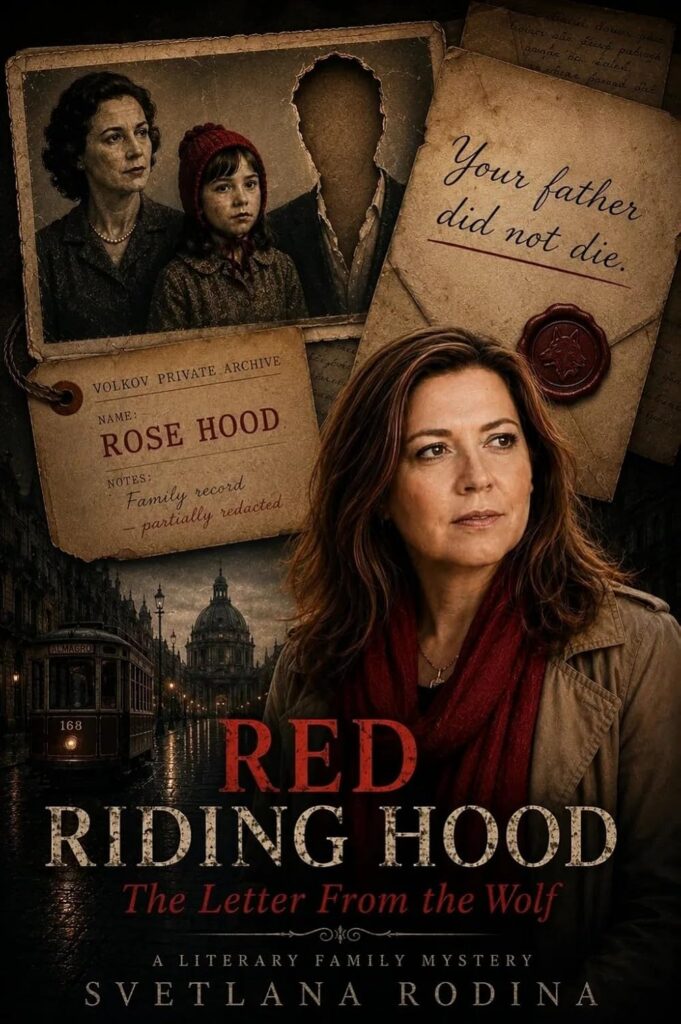
While working on my novel Red Riding Hood: The Letter from the Wolf, I kept returning to a deceptively simple question: what happens when new information about your family changes not only what you know about other people, but the story you have been telling about yourself?
The protagonist, Rose, is 53. Photographs, letters, and family documents begin to contradict parts of the history she has accepted for decades. The documents matter, but what interested me more was what came after them. Facts can change the meaning of the past, and sometimes that change reaches surprisingly far into the present.
If someone you blamed for years turns out to have been more complicated than you knew, what happens to the anger you built around the simpler version? If the story about your parents changes, does your own story shift with it? And if the role you have played in your family was partly based on an incomplete understanding of the past, how much of that role still belongs to you?
These are fictional questions in the novel, but they are not particularly fictional in life.
The Family Version of the Truth

Every family has stories it tells easily and stories it tells badly.
Some are polished through repetition. We know exactly who was brave during the crisis, who made the sacrifice, who was unreliable, who held the family together. Other stories are reduced to a sentence, avoided entirely, or remembered differently depending on who is speaking.
This does not mean families spend their evenings deliberately rewriting history. Memory is less organized than that. People experience the same event from different positions; children misunderstand what adults are trying to hide; adults simplify complicated circumstances because the full explanation seems unnecessary, painful or inappropriate at the time.
Years later, the simplified version remains.
A grandmother becomes “the woman who gave up everything for her children.” A father becomes “emotionally distant.” An aunt becomes “the selfish one.” A marriage becomes “happy.” Another relative becomes the person nobody discusses.
Such descriptions may contain a good deal of truth while leaving just as much outside the frame.
We inherit them anyway, and sometimes they concern us.
A girl repeatedly praised for being independent may become highly capable, but she may also absorb the idea that needing help is a kind of failure. The daughter who was always “the reasonable one” may grow into an adult who knows how to manage everybody’s emergencies and has no idea what to do with her own.
Sometimes the contradiction becomes almost comic in its ordinariness. A woman can sit at a family dinner listening to someone say, “You’ve never liked taking risks,” and suddenly realize that since the last person at that table really knew her well, she has changed jobs, raised two children, divorced, moved to another city and started over financially. Nobody is lying. The family simply has an older edition of her.
That is what makes these roles difficult to leave. They are rarely entirely false, and they may once have served us well.
The more useful question is not whether a description was once accurate, but whether it is still accurate enough to organize a life around.
What Changes With Age Is Not Necessarily Who We Are
The language around women over 50 often relies on reinvention. We are told to begin again, discover ourselves, start a second act, become fearless.
I understand the appeal, but I am not convinced that reinvention is always the right word.
Most women have already spent decades becoming and adapting. They have made decisions under pressure, changed careers, raised children or chosen not to have them, cared for parents, ended relationships, maintained them, moved, stayed, earned money, lost it and solved problems nobody had prepared them for.
They are hardly unfinished drafts waiting for a dramatic rewrite.
What age can give us instead is perspective.
At 25, a family description may still feel like evidence. At 50, we have accumulated evidence of our own.
The woman who was supposedly afraid of change can look at the changes she actually survived. The “impractical” daughter can count the crises she handled. The one accused of selfishness may finally notice that the accusation appeared whenever she set a boundary. The “strong one” may begin to suspect that strength has been used as a convenient reason not to ask whether she is tired.
Experience does not automatically make anyone wiser, but it does give us more to compare against the conclusions we inherited years ago. Looking back, we may find that some of those old descriptions still fit, while others feel strangely outdated, as if they belong to a younger version of us, or perhaps to someone else’s idea of who we were. What follows may look less like reinvention than a gradual revision of the story.
When the Past Acquires Another Meaning

Family stories rarely collapse in one cinematic revelation. More often, they shift by degrees.
An elderly relative remembers something differently. A photograph contradicts a date. A letter reveals what someone was dealing with at the time. A conversation supplies a piece of context that was missing when we were children.
Nothing about the original event changes, yet its meaning may.
The mother who seemed indifferent may have been frightened. The marriage everyone described as enviable may have contained years of loneliness. The relative who “abandoned the family” may have been trying to survive it.
New context does not excuse everything, nor should it. Understanding is not the same thing as absolution.
A parent may have loved us deeply and misunderstood us. A mother may have sacrificed enormously for her children and unintentionally taught her daughter that self-sacrifice was the price of being a good woman. A belief may have protected one generation and confined the next.
Adulthood allows us to hold those contradictions without forcing the past into a simple verdict.
The Story Does Not Have to Be Destroyed to Be Revised
Questioning an inherited story can feel surprisingly disloyal.
If our parents did their best, why examine what they misunderstood? If our childhood was mostly happy, why revisit its inaccuracies? If the people involved are gone, what exactly are we hoping to accomplish?
Perhaps nothing dramatic.
Perhaps the purpose is simply to stop allowing an old interpretation to make present-day decisions for us.
A useful test is to notice the sentences that still appear automatically when you think about yourself: I am not the kind of person who… I have always been… In our family, women never… Everyone knows I am terrible at…
Then ask where that sentence came from and whether your adult life still supports it.
Not whether it was once true. Not whether somebody had a reason to believe it.
Whether it is true now.
We do not need to declare our families wrong in order to become more accurate about ourselves. We can love our parents without adopting every fear they carried. We can respect the choices our mothers made without repeating all of them. We can understand why a family needed a particular story and decide that we no longer need it in quite the same form.
There is no requirement to throw away the family album.
Sometimes all that changes is the caption beneath the photograph.
And perhaps one of the quieter privileges of getting older is realizing that we are finally allowed to write some of those captions ourselves.