
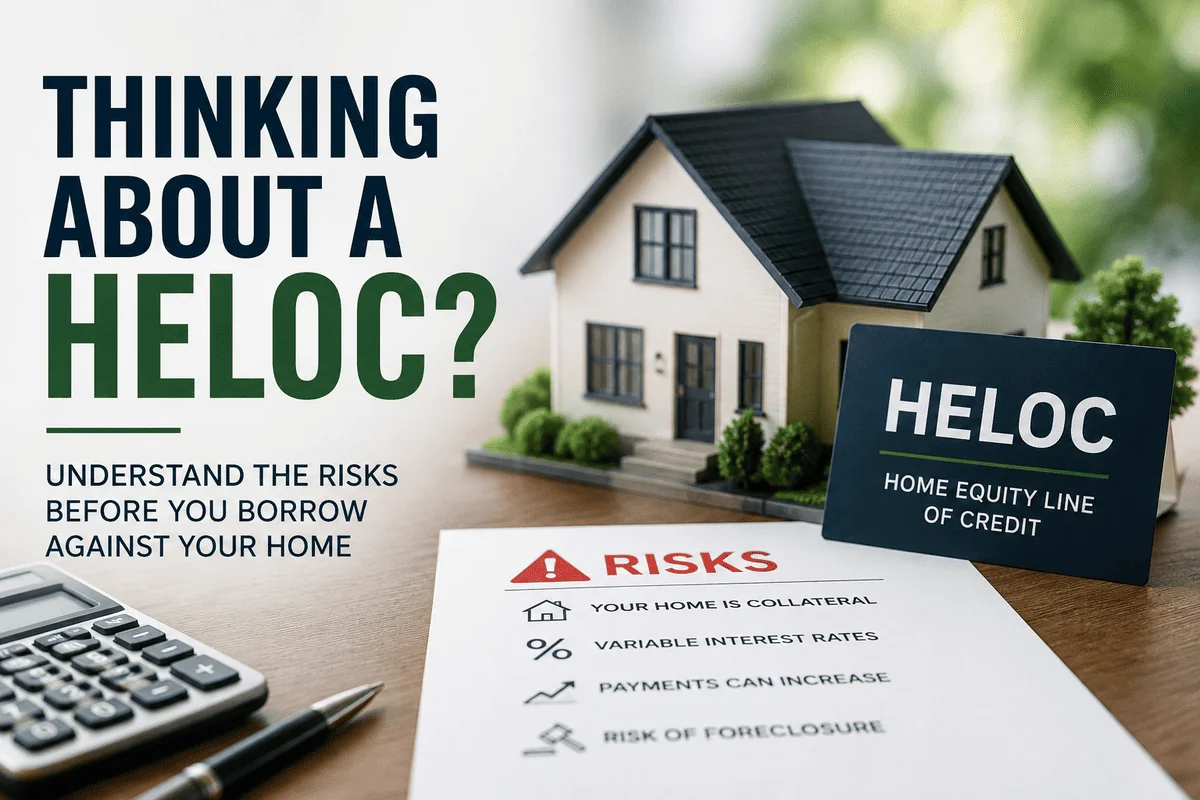
Your home likely represents your most valuable asset, built through years of careful planning and financial commitment. A home equity line of credit can offer flexible access to funds for significant expenses such as renovations, education or medical costs.
While there are various home equity line of credit (HELOC) pros and cons, borrowing against your home equity deserves thoughtful consideration of the risks involved, from variable rates to using your property as collateral.
The Reality of Using Your Home as Collateral
A HELOC is secured by your home, which fundamentally distinguishes it from unsecured borrowing options like personal loans or credit cards. When you take out a HELOC, the lender holds a claim against your property if you fail to repay what you owe. This arrangement typically results in lower interest rates compared to unsecured debt, but the trade-off carries substantial weight.
Defaulting on your HELOC can lead to foreclosure of your home. Before borrowing, establish a realistic repayment plan based on your current income and existing financial obligations. Your available equity differs significantly from your disposable income. A lender might approve you for a large credit line based on your home’s value and existing mortgage balance, but that amount doesn’t reflect what you can comfortably afford to repay.
A HELOC generally functions as a second lien behind your primary mortgage, adding another monthly obligation while you remain responsible for your home loan, property taxes, insurance and maintenance.
The Impact of Variable Interest Rates
Most HELOCs carry variable interest rates, meaning your borrowing cost can rise when the underlying benchmark rate increases. Your monthly payment can change over time, which makes long-term budgeting more challenging than with a fixed-rate loan.
Before borrowing, calculate what your payment might look like if rates increased by two or three percentage points. This stress test can reveal whether the debt would remain manageable during less favorable economic conditions. Ask about the index used to determine your rate, the margin added, how frequently the rate can adjust and whether caps or floors limit rate movement. If payment predictability matters, consider a fixed-rate option.
Navigating Draw Periods and Repayment Periods

HELOCs commonly operate in two phases. During the draw period, you can borrow from your available credit line and typically make smaller payments. The repayment period follows, when you generally can no longer draw funds and must repay the outstanding balance through principal-and-interest payments.
Low initial payments during the draw period don’t mean low-cost borrowing. Some HELOCs allow interest-only payments during this phase, which keeps early costs manageable but doesn’t reduce the principal you owe. When the repayment period begins, your payment could increase substantially.
A borrower who has consistently drawn against the line might face a much higher payment. Review your loan agreement early to understand when repayment begins and estimate future payments.
How to Avoid the Temptation of Over-borrowing
A large credit limit can create the illusion of extra spending power, but available credit isn’t the same as money you can afford to spend. Before drawing funds, identify the specific expense and assess how the debt fits your monthly budget.
Using home equity for necessary repairs or improvements is easier to justify than repeatedly drawing against your home for vacations or luxury purchases that don’t build lasting value. Establish a personal borrowing ceiling based on your income, existing mortgage, emergency savings and other debts.
A HELOC might help consolidate higher-interest debt, but transferring balances doesn’t make underlying spending problems disappear. If the credit line creates room for additional borrowing, you could end up in deeper debt.
Watching Out for Hidden Fees and Closing Costs
The advertised interest rate doesn’t capture the complete picture. Ask your lender for a detailed breakdown of application fees, origination charges, appraisal costs, title fees, annual maintenance fees and transaction fees.
Some lenders advertise low-cost or no-cost HELOCs, but conditions often attach. Determine whether the lender is absorbing closing costs, rolling them into your balance or making them subject to repayment if you close the line early.
A credit line can carry fees even when you’re not actively borrowing, including annual maintenance fees or minimum-use fees. Some lenders charge a fee if you close your HELOC within the first few years.
Exploring Safer Alternatives for Your Financial Goals
For smaller expenses, paying cash from savings may eliminate interest charges and avoid putting your home at risk. Just be careful not to drain your emergency fund completely.
Personal loans typically carry higher rates than HELOCs, but they do not use your home as collateral. The team at Members 1st Federal Credit Union offers personal loans with several terms and competitive rates. The Members 1st HELOC also allows borrowers to lock in all or part of their balance at a fixed rate for one to 15 years, with up to three fixed terms at a time.
If you know exactly how much you need and prefer predictable payments, a traditional home equity loan may be worth considering. It provides a lump sum rather than revolving access, and fixed-rate structures make budgeting easier.
For large projects, investigate contractor financing or renovation loans alongside a HELOC. Sometimes the safest move is to delay a purchase or save over time.
Frequently Asked Questions
These common questions help clarify key considerations when evaluating HELOC pros and cons.
What are HELOC pros and cons?
HELOCs offer flexible access to funds at lower interest rates than unsecured borrowing, and you only pay interest on what you draw. However, they use your home as collateral, putting your property at risk if you default. Variable rates can cause payment fluctuations, and the transition from draw to repayment periods can create payment shock.
What happens if I can’t repay my HELOC?
Failing to repay your HELOC can lead to foreclosure. If you’re experiencing financial difficulty, contact your lender immediately to discuss options before missing payments.
Will my HELOC payments stay the same?
Most HELOCs have variable interest rates, so payments can change as rates fluctuate. Your payment will also typically increase substantially when you transition from the draw to the repayment period. Fixed-rate lock options can provide payment stability.
Do I have to pay fees on a HELOC?
Potential fees include application charges, origination fees, appraisal costs, title fees, annual maintenance fees and early-closure penalties. Fee structures vary by lender, so request a complete fee schedule and review all disclosures carefully.
Make the Right Choice for Your Financial Future
A HELOC can serve as a valuable tool when used carefully. Before borrowing, assess whether the expense justifies using your home as collateral, whether you can manage payments even if rates rise and whether safer alternatives might serve your needs better.