

Divorce creates enough paperwork without discovering that college financial aid has its own definition of “parent. Yet when your child starts applying to college, who fills out the FAFSA can make a meaningful difference in how the family’s finances are presented. The rules are also not necessarily the ones you remember from an older child’s application, which is where things get especially fun.
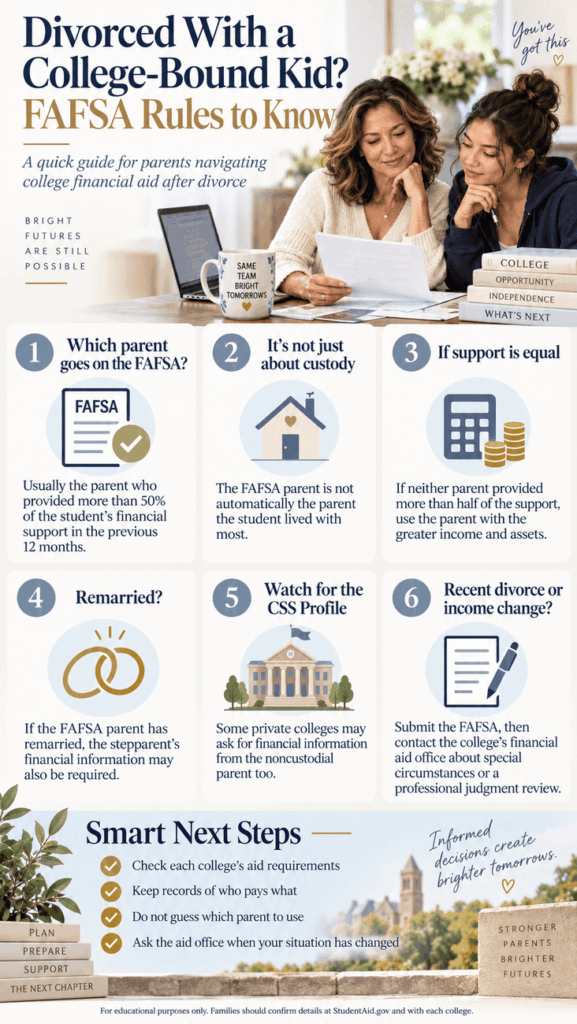
Under the current FAFSA system, divorced and separated parents need to determine which parent provided the greater share of the student’s financial support during the previous 12 months. That parent’s information generally goes on the FAFSA, even if the student lived primarily with the other parent.
If you are thinking, “Wait, I thought it was the parent the child lived with most,” you are remembering the old rules.
The FAFSA No Longer Simply Follows the Custody Schedule
For years, divorced parents were generally told to use the financial information of the parent with whom the child lived most during the previous 12 months.
That changed with FAFSA simplification. For the 2026–27 FAFSA, Federal Student Aid says the parent who provided more than 50 percent of the student’s financial support during the previous 12 months is the parent whose financial information should be used. The federal handbook specifically notes that this may be a different parent from the one the student lived with.
Child support and alimony paid to the other parent can count toward the paying parent’s support when determining which parent provided the majority, according to the federal guidance. That can produce some situations families are not expecting.
For example, your teenager may live mostly with you while your former spouse pays substantial child support and covers other major expenses. The FAFSA parent could therefore potentially be your former spouse rather than you.
What If You Both Support Your Child Equally?
Federal Student Aid acknowledges that occasionally neither parent provides more than half of the student’s support.
If financial support was exactly equal, or if neither parent provided financial support, the FAFSA instructs the family to use the parent with the greater income and assets.
This is one area where guessing can create problems. Federal Student Aid offers a “Who’s My FAFSA Parent?” tool specifically to help separated and divorced families determine which parent should participate.
I would use it. College applications already provide plenty of opportunities for family arguments. “Whose income belongs on this federal form?” does not need to become another one.
Remarriage Can Change the Financial Picture
Here is another surprise. If the parent whose information belongs on the FAFSA has remarried, the stepparent’s financial information may also become part of the application. The 2026–27 FAFSA instructions state that when the responsible parent is remarried, information about that parent and stepparent is required.
Whether the stepparent must personally participate as a FAFSA contributor depends partly on how the couple filed their taxes. If the parent and current spouse filed a joint federal tax return, only one may need to participate as the contributor. If they did not file jointly, the spouse may need a separate invitation to complete their portion of the FAFSA.
This sometimes catches remarried families off guard.
Your new spouse may have no intention of paying your child’s tuition. Unfortunately, the FAFSA is calculating eligibility under federal aid rules, not enforcing your household’s personal college financing agreement.
A prenup, divorce decree, or firmly stated “his kids are his expense and mine are mine” does not automatically make the stepparent’s finances disappear from the formula.
Divorce Does Not Automatically Make Your Child Independent
Another common misconception is that a student with divorced parents can simply file the FAFSA independently. Usually, this is not the case.
Federal dependency rules are based on criteria such as the student’s age, marital status, graduate student status, military service, certain dependent children, foster care history, legal guardianship, or other specified circumstances. Parental divorce by itself does not make a typical undergraduate student independent for federal aid purposes.
In other words, your 18-year-old cannot solve a complicated parent contribution problem by checking a box that essentially says, “These people are divorced and I would prefer not to get involved.”
If only federal paperwork worked that way.
Then There Is the CSS Profile
The FAFSA is not necessarily the end of the story. Some private colleges and scholarship programs also require the CSS Profile, which is administered by the College Board and used to distribute institutional financial aid. The College Board says CSS Profile information helps colleges award more than $14 billion in nonfederal aid each year.
For divorced families, the CSS Profile can be more complicated because some participating colleges require financial information from both the custodial and noncustodial parent. The noncustodial parent may have to create a separate account and complete a separate CSS Profile.
That means a family could correctly report only one household on the FAFSA and still be asked for the other parent’s financial information by a college when determining its own institutional aid.
This is why I would never look at the FAFSA alone when comparing financial aid expectations at private universities.
What If Your Ex Refuses to Cooperate?
This may be the part divorced parents worry about most.
If a college requires the noncustodial parent’s CSS Profile and that parent refuses to participate, the student should contact the college’s financial aid office immediately rather than simply leaving the application incomplete.
The College Board provides a Noncustodial Parent Waiver Request for situations in which the student has no contact with the noncustodial parent or other circumstances may justify a waiver. Each college decides whether it will approve the request.
Do not wait until two days before the college’s financial aid deadline to discover this requirement.
As anyone who has ever tried to get a difficult former spouse to locate a tax return can tell you, “I need this tonight” rarely improves the situation.
A Recent Divorce May Not Be Reflected in the Tax Information
There is another important issue for women who divorced recently.
The income information automatically transferred into a FAFSA may reflect a tax year when you were still married or when your household income looked dramatically different.
Federal Student Aid allows college financial aid administrators to consider special financial circumstances and make what is called a professional judgment adjustment when the FAFSA no longer accurately represents the family’s financial reality.
The federal handbook even gives an example involving parents who were married when the relevant tax return was filed but later divorced. In that example, the financial aid administrator uses more recent financial information from the parent now responsible for the FAFSA and updates other household details accordingly.
If your financial situation has changed substantially because of divorce, job loss, reduced income, large medical expenses, or another major event, submit the FAFSA as instructed first and then contact the school’s financial aid office about an adjustment. Federal Student Aid specifically advises families to follow that process when their current finances are not accurately represented on the form.
Keep Better Records Than You Think You Need
For divorced families approaching college, I would start keeping track of who actually pays for what.
Tuition is obvious, but financial support can extend well beyond tuition. Child support, housing, insurance, transportation, food, and other expenses may become relevant when determining who provided the greater share of support.
You do not need to create a forensic accounting department in your spare bedroom. You do want enough documentation that you are not sitting at the computer next fall saying, “I think he paid more, unless we count the car, but I paid the insurance, except he paid the orthodontist…”
A simple shared spreadsheet or folder containing major expenses can save an enormous amount of aggravation.
Do Not Choose a Parent Based on Who Has the Lower Income
It can be tempting to look at two divorced households and assume you should simply put the lower earning parent on the FAFSA because that might produce more aid. That is not how the form works.
Families are expected to follow the federal rules for determining the required parent contributor. Intentionally using the wrong household because the numbers are more favorable can create verification problems and delay or jeopardize financial aid.
The smarter strategy is to understand the rules early enough to avoid surprises and then appeal when your actual financial circumstances genuinely are not reflected accurately.
The Bottom Line
Divorce can absolutely affect college financial aid, but not always in the ways parents expect.
For the current 2026–27 FAFSA, the key question for divorced or separated parents is generally who provided the greater portion of the student’s financial support during the previous 12 months, not simply where the student slept most nights. If that parent has remarried, the stepparent’s financial information may enter the picture as well.
Private colleges using the CSS Profile may go even further and request information from both households.
My advice is to figure out your family’s FAFSA parent before application deadlines arrive, check whether each college also requires the CSS Profile, and contact financial aid offices when a recent divorce or major income change makes the numbers on paper look nothing like your life today.
College is expensive enough. You do not need to lose financial aid because everyone was working from an outdated version of the rules.