
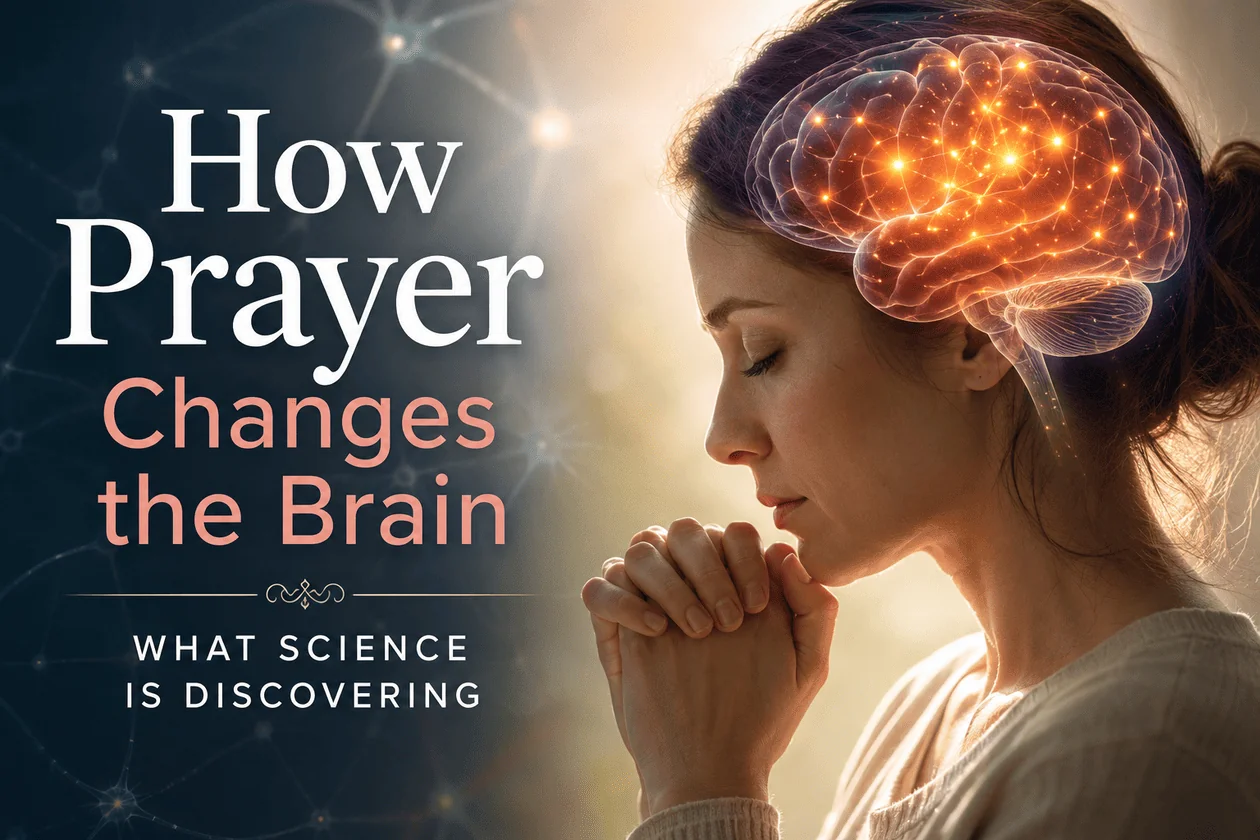
For centuries, people have turned to prayer for comfort, guidance, healing, and connection with God. While prayer has long been viewed as a spiritual practice, modern neuroscience is uncovering something remarkable: prayer appears to have measurable effects on the brain itself.
Advances in brain imaging technology have allowed scientists to observe what happens inside the brain during prayer. While research cannot determine whether God hears or answers prayer, it can reveal how prayer influences attention, emotions, stress levels, and even the brain’s physical structure over time. The results are fascinating.
Prayer Strengthens the Brain’s Focus and Attention Systems
Anyone who has spent time in deep prayer understands that it requires concentration. Neuroscientists have found evidence that the brain reflects this effort.
Dr. Andrew Newberg, a leading researcher in the emerging field of neurotheology, has spent decades studying people engaged in prayer and meditation using brain imaging technology. His research has consistently shown increased activity in the frontal lobes aka the areas of the brain responsible for focus, planning, attention, and intentional behavior.
“When people pray deeply, they are exercising many of the same neural circuits involved in concentration and self-control,” Newberg explains.
This increased activity may help explain why many people report feeling mentally clearer, more focused, and less distracted after spending time in prayer.
Prayer May Reduce Stress and Anxiety
One of the most significant findings from neuroscience research is prayer’s potential impact on stress. When we experience fear or anxiety, a small almond-shaped structure in the brain called the amygdala becomes highly active. The amygdala acts as the brain’s alarm system, preparing the body to respond to threats.
Research on contemplative spiritual practices suggests that prayer and meditation can help regulate this stress response. Regular prayer appears to strengthen connections between the brain‘s emotional centers and the prefrontal cortex, which helps us evaluate situations more calmly and thoughtfully.
As a result, people who pray regularly often report greater emotional resilience, lower anxiety levels, and an increased sense of peace during difficult circumstances. A 2025 review published in Frontiers in Psychology found that prayer was associated with improved emotional well-being, reduced psychological distress, and stronger coping mechanisms during periods of stress.
Prayer Engages the Brain’s Relationship Networks

Perhaps the most intriguing discovery is that prayer activates some of the same brain regions used in human relationships. In a landmark study published in Social Cognitive and Affective Neuroscience, researchers used functional MRI scans to examine the brains of Christians engaged in personal prayer.
The study found increased activity in the medial prefrontal cortex and temporoparietal junction—areas involved in understanding other people, maintaining relationships, and interpreting thoughts and intentions.
Researchers concluded that participants appeared to engage with God neurologically in much the same way they would engage with another person in a meaningful relationship. For believers, this finding is particularly compelling. It suggests that when people pray, the brain processes the experience as a genuine relational interaction rather than merely a recitation of words.
Prayer Can Change the Brain Through Neuroplasticity
One of the most important discoveries in neuroscience over the last several decades is neuroplasticity, the brain’s ability to change and adapt throughout life. Every repeated thought, habit, and behavior strengthens certain neural pathways. The more often those pathways are used, the stronger they become.
Prayer appears to work in a similar way. When individuals regularly engage in prayer, they repeatedly activate neural networks associated with attention, self-reflection, emotional regulation, gratitude, compassion, and meaning-making. Over time, these networks may become more efficient and more dominant.
In simple terms, prayer doesn’t just influence how we feel in the moment. It may gradually influence how our brains are wired. Researchers studying long-term spiritual practices have found evidence of structural and functional changes in brain regions related to awareness, empathy, and emotional control.
Prayer May Increase Compassion and Empathy
Many religious traditions teach that prayer should transform not only our relationship with God but also our relationships with others. Interestingly, neuroscience supports this idea.
Studies have shown increased activity in areas such as the anterior cingulate cortex and insula during contemplative spiritual practices. These regions play important roles in empathy, compassion, emotional awareness, and understanding the feelings of others.
Researchers believe that regularly engaging these networks may help strengthen prosocial behaviors such as kindness, patience, forgiveness, and generosity. This may explain why many people report becoming more compassionate and less reactive as prayer becomes a consistent part of their lives.
What Science Cannot Tell Us

While neuroscience has made tremendous advances, it also has limitations.
Brain scans can show which areas become active during prayer. They can measure changes in blood flow, electrical activity, and neural connectivity. What they cannot determine is whether a spiritual experience originates solely within the brain or involves an actual encounter with God.
Science can observe the effects of prayer. It cannot evaluate the spiritual reality behind it. That distinction is important. Neuroscience helps us understand the biological mechanisms involved in prayer, but questions of faith ultimately extend beyond what a brain scan can measure.
The Bottom Line
The growing body of research on prayer and the brain suggests that prayer is far more than a religious ritual. Studies indicate that prayer can strengthen attention, improve emotional regulation, reduce stress, activate relationship-centered brain networks, and potentially reshape neural pathways through neuroplasticity.
For believers, these findings provide a fascinating intersection between faith and science. While researchers continue to explore exactly how prayer affects the brain, one conclusion is becoming increasingly clear:
Prayer appears to change the person who prays. And according to neuroscience, that change may be happening one neural pathway at a time.
Research Sources:
- Schjoedt, U., et al. (2009). Highly Religious Participants Recruit Areas of Social Cognition in Personal Prayer. Social Cognitive and Affective Neuroscience.
https://pmc.ncbi.nlm.nih.gov/articles/PMC2686228/ - Newberg, A. Research Publications and Neurotheology Studies.
https://www.andrewnewberg.com/research/ - Frontiers in Psychology. Prayer and Mental Health Outcomes (2025).
https://www.frontiersin.org/articles/10.3389/fpsyg.2025.1569514 - Van Gordon, W., et al. Neuroscience of Meditation and Spiritual Practice.
https://arxiv.org/abs/1603.06342 - National Center for Biotechnology Information (NCBI) – Prayer and Brain Function Research Collection.
https://www.ncbi.nlm.nih.gov/