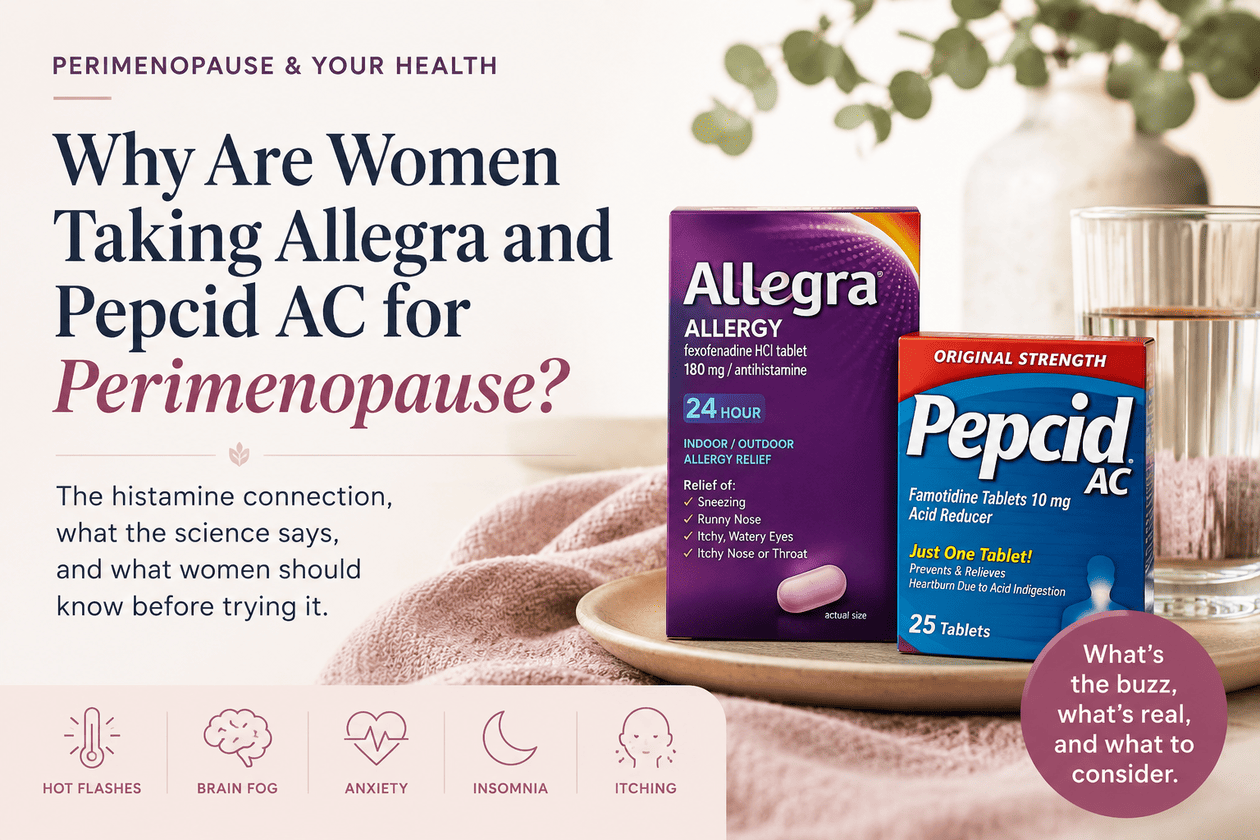
If you’ve spent any time on TikTok, Reddit, or women’s health forums lately, you’ve probably seen women talking about a surprising combination for perimenopause symptoms: Allegra and Pepcid AC. Yes, the allergy medicine and the heartburn medicine.
Women (including some of my personal friends) are reporting improvements in everything from hot flashes and anxiety to insomnia, itching, racing heartbeats, joint pain, and brain fog. And naturally, many of us are asking the same question:
Wait… what exactly is going on here? Like many viral health trends, the answer is somewhere between “there may be something to this” and “social media got ahead of the science.”
The Histamine Connection
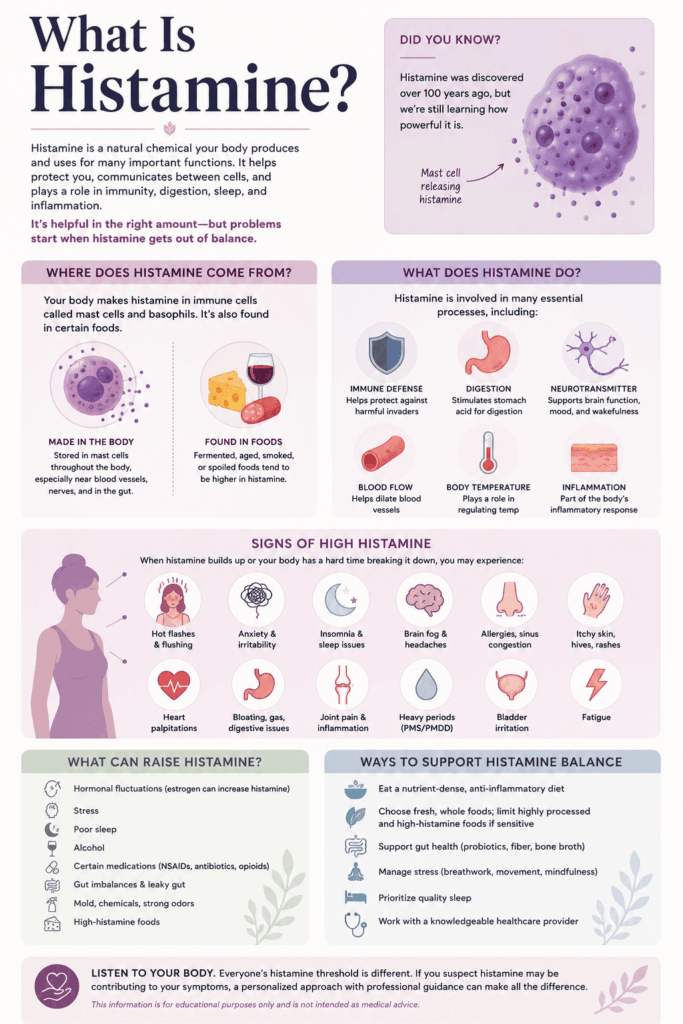
The theory behind this trend centers around histamine. Most of us think of histamine as something involved in allergies: pollen, sneezing, itchy eyes, hives. But histamine actually does much more than that. It’s also involved in the nervous system, digestion, sleep regulation, inflammation, and body temperature control.
And here’s where it gets interesting for women in perimenopause: Estrogen and histamine appear to influence one another.
Higher estrogen levels can stimulate histamine release, and histamine can, in turn, stimulate more estrogen production. During perimenopause, when hormones are fluctuating wildly rather than declining in a smooth line, some women may become more sensitive to histamine.
That sensitivity could potentially contribute to symptoms like:
- anxiety
- insomnia
- headaches
- flushing
- heart palpitations
- skin itching
- digestive issues
- feeling “wired but exhausted”
Sound familiar?
Why Allegra and Pepcid?
Allegra is an H1 antihistamine. Pepcid AC (famotidine) is an H2 blocker. Together, they block different histamine receptors in the body. Online, some people refer to this as a “full histamine blockade.”
The idea is that reducing histamine activity may calm some of the symptoms women experience during perimenopause. And to be fair, some women say it has helped them tremendously. But there’s an important distinction here: Anecdotes are not the same thing as evidence.
What the Science Actually Says
Right now, there are no large clinical studies showing that Allegra and Pepcid are proven treatments for perimenopause. That doesn’t mean women are imagining their relief. It simply means the medical research hasn’t caught up yet.
There is growing scientific interest in:
- mast cell activation
- histamine intolerance
- hormone-histamine interactions
- inflammation during menopause transition
So biologically, the theory is plausible. But medicine has not yet established antihistamines as a standard or evidence-based treatment for perimenopause symptoms.
And honestly? This is where many women feel frustrated. Because women have spent years being told:
- “It’s just stress.”
- “You’re aging.”
- “Your labs are normal.”
- “Maybe try getting more sleep.”
So when women discover something over-the-counter that appears to help, the information spreads quickly. I’ve had two friends tell me that it’s like a miracle for them in the last week.
The Bigger Conversation
One reason this trend has resonated so deeply is because it highlights something important: Women are still struggling to get adequate care and information about perimenopause.
Many women enter their 40s having no idea that symptoms like anxiety, insomnia, heart palpitations, dizziness, rage, itching, or brain fog can be connected to hormonal shifts. Instead, they feel blindsided. So they turn to one another. That collective sharing can be incredibly valuable. Women often identify patterns long before medicine formally studies them.
But social media can also oversimplify complicated health issues. Not every symptom is caused by histamine. Not every woman in perimenopause has histamine sensitivity. And not every viral wellness trend is harmless.
A Few Important Cautions
Even though Allegra and Pepcid are over-the-counter medications, they are still medications. That matters.
Antihistamines can interact with other drugs and may not be appropriate for people with certain health conditions. Persistent symptoms like heart palpitations, severe anxiety, sleep disruption, or digestive problems deserve proper medical evaluation rather than self-diagnosis through TikTok.
It’s also possible that some women experiencing relief may actually have:
- underlying allergies
- mast cell issues
- histamine intolerance
- inflammatory conditions
- gastrointestinal disorders
In those cases, antihistamines might genuinely help — but the issue may be broader than perimenopause itself.
So… Is It Worth Trying?
Not gonna lie. I’m trying this tomorrow, but I cannot recommend this for others because I am not remotely a health expert. I’m just a writer. Which means, it’s a conversation best had with a knowledgeable healthcare provider, especially if symptoms are significant or ongoing.
But perhaps the most useful takeaway from this trend is not the Allegra or the Pepcid. It’s this: Women are hungry for answers. Women are comparing notes. And women are finally talking openly about what perimenopause actually feels like. Frankly, that part is long overdue.